
December 12, 2025 · 9 min
If you travel with your Bitcoin backup, you’ve probably had this thought standing in the security line: Can Airport Scanners Read Your CRYPTOTAG? We Put It to the Test
“What if the airport security scanner can see my seed phrase?”
At Cryptotag, we've been getting this question more and more. Customers take their Zeus or Thor plates on holidays, business trips, or even permanent moves to other countries. They trust the metal, they trust the design, but they don’t quite trust the mysterious machines at the airport.
We didn’t want to answer this with “it should be fine” or “probably safe”. So we decided to do what we always do: test it for real. Not in a slideshow, not in a simulation, but with serious hardware and independent experts.
To make sure this wasn’t just a marketing stunt, we asked a partner who lives and breathes high-end imaging: Carl Zeiss SMT (Zeiss Metrology).
Carl Zeiss SMT is a German company and an industry leader in industrial metrology (the science of measuring and inspecting parts with extreme precision). Their systems are used in chip fabrication, automotive and aerospace, construction and precision engineering, medical technology, and cutting-edge tech.
If you zoom out a bit, you’ll find their world overlaps strongly with ours. Their customers and partners include names like ASML, TSMC, Intel, and Samsung. Companies that sit at the core of the global semiconductor ecosystem. When the most advanced chips in the world are being manufactured, it’s often Zeiss technology checking whether those chips are within nanometer tolerances.
That’s why we chose Zeiss for the test. If anyone could use CT and X-ray equipment to see inside a titanium plate and expose what’s on it, it would be a company like this.
The tests were carried out in their facility in Breda, the Netherlands, using one of their high-end industrial CT systems. In other words: not just “like an airport scanner”, but far more capable.
Before we get into the lab, it helps to understand what happens to your bag at the airport.
When your backpack or cabin bag disappears into that rubber curtain, it usually passes through one of two types of scanners.
The first is the classic X-ray scanner. Your bag travels on a belt through a tunnel with an X-ray source on one side and detectors on the other. The system produces a flat 2D image that a security or customs officer can view from different angles. Modern systems use “dual-energy” X-rays so they can color different materials: organic items, metals, plastics, making explosives and weapons easier to spot. Dense metal, like a block of titanium, appears as a very dark, opaque area. You can clearly see there’s something heavy and metallic there, but fine detail inside that object is essentially gone.
The second type, which more and more major airports are adopting, is CT (computed tomography) for cabin baggage. If you’ve ever had a medical CT scan, the principle is similar: the system takes many X-ray images from different angles and reconstructs a 3D model. Security staff can then rotate and “scroll” through slices of your bag on screen. Software helps by automatically flagging suspicious shapes and materials, including liquids.
These machines are outstanding at what they’re designed for: spotting weapons, explosives, batteries, wires, unusual shapes, and densities in a bag full of everyday stuff.
They are not designed to read small text or reconstruct tiny punched dents hidden between two tightly mated metal plates. That’s simply not their job and not what their resolution, algorithms, or workflows are tuned for.
But we wanted to see what would happen if we went way beyond airport conditions.
For the test, we used a Cryptotag Zeus style setup: two 3 mm thick titanium plates, with the seed punched on the inner faces. Once assembled, those punched surfaces face each other, invisible from the outside.
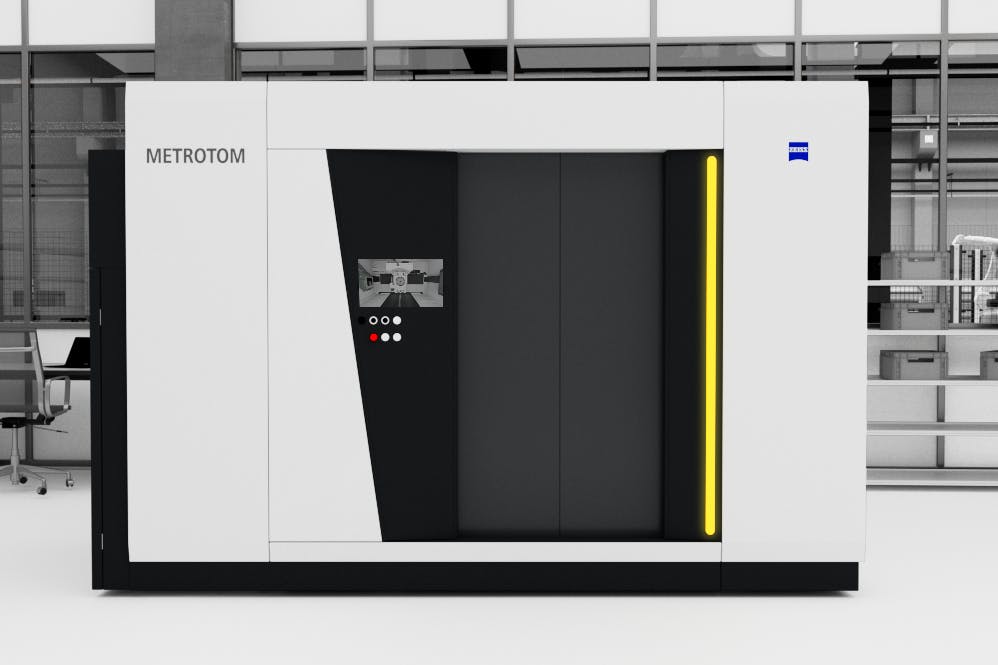
At the Zeiss facility in Breda, the plates were scanned on a MetroTom 1500 system with a 3K detector. An industrial CT machine that manufacturers use to inspect critical components in great detail. We deliberately ran the scans across a wide range of settings:
Tube voltage between 140 kV and 220 kV. Tube currents from 200 µA up to 800 µA. Voxel sizes (think of this as 3D pixel size) between 39 µm and 150 µm.
For comparison: airport CT scanners are optimized for speed and throughput, not for resolving microscopic structures. The 39 µm resolution we used is far finer than what’s realistic in a busy security lane.
We also scanned the plates in different orientations and configurations so we could see how the system behaved in both “typical” and “best-case” scenarios.
If there was any realistic way to read a seed through titanium, this setup should have given us a chance to see it.
The first thing the CT images showed was exactly what you’d expect: a dense, bright block of titanium on the screen.
The machine clearly recognized that there were two plates pressed together and could outline the overall shape and edges of the product without any trouble. So yes, any scanner, at an airport or lab, can see “there is a solid metal object here”.
The interesting part is what happens on the inside.
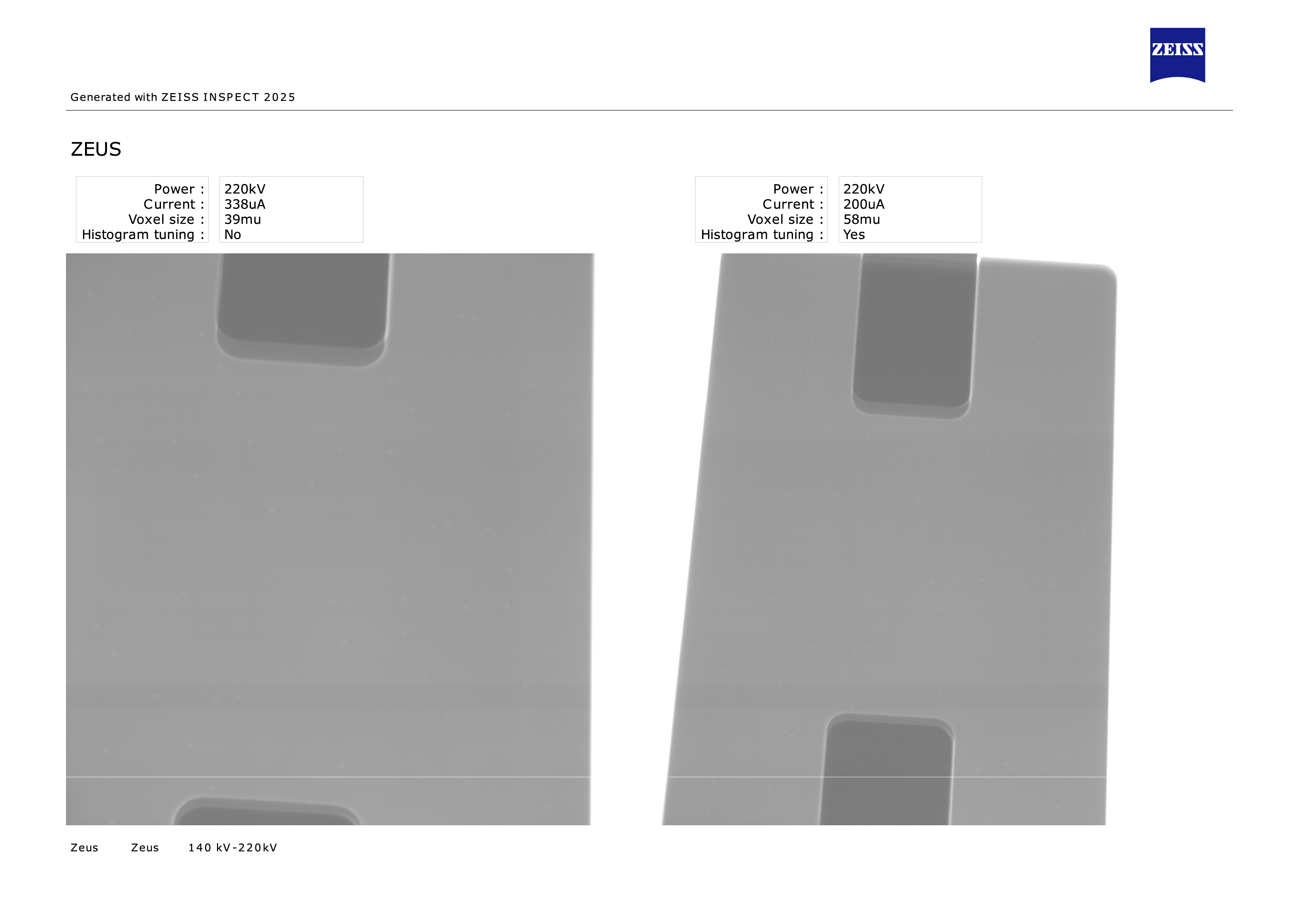
At coarser resolutions closer to what you’d expect in an airport environment, the interior of the plates looked essentially solid. The CT system simply did not resolve the fine details of the punched pattern.
Even when we pushed the equipment much harder (smallest voxel size, higher currents and voltages, careful positioning), we only saw indications of spots. In some of these best-case images, you could spot tiny hints of individual dents from some punched dots, often at the edges or in the most favorable orientations.
But even then, the picture was incomplete and messy. Dense metals are notoriously difficult for CT: they create artefacts, streaks and distortions that blur fine detail. The result was that you could see that “something” had been punched into the inside surfaces, but not in a way that allowed us to reconstruct full letters, words, or a seed phrase. And even if an airport security employee would be able to reconstruct the dots, the margin for error would be huge, and the worker would only have one part of the seed phrase to work with.
And remember: all of this was in a clean, controlled environment, with plenty of time, using a machine that is more powerful and more precise than what you walk past at the airport.
Our tests were already more generous to an imaginary attacker than reality would ever be. We scanned the plates alone, in clear view, with no laptop, cables, clothes, books or snacks around them. We could choose the angle and take as long as we liked.
That is the opposite of an airport.
In the real world, your Cryptotag is just one object in a messy bag. It might be next to a laptop battery, tangled in charger cables, sandwiched between toiletries and a sweater. Security CT has to scan that whole mess in a fraction of a second and show something useful to an operator whose job is to spot threats, not decode microscopic punch marks.
So if, even under lab-grade conditions, we could only see vague hints of a few dents, the picture at an airport is clear:
When your Cryptotag is packed in a bag, it is practically impossible to see what data it holds from the scanner image. At most, someone with extremely specialized tools might guess that there are dents on some inner surface, but not what they mean.
You can see that the machine sees right through the Airtag that is placed in front of the Cryptotag plates, and right through the Ledger wallet and the iPhone in the right image.
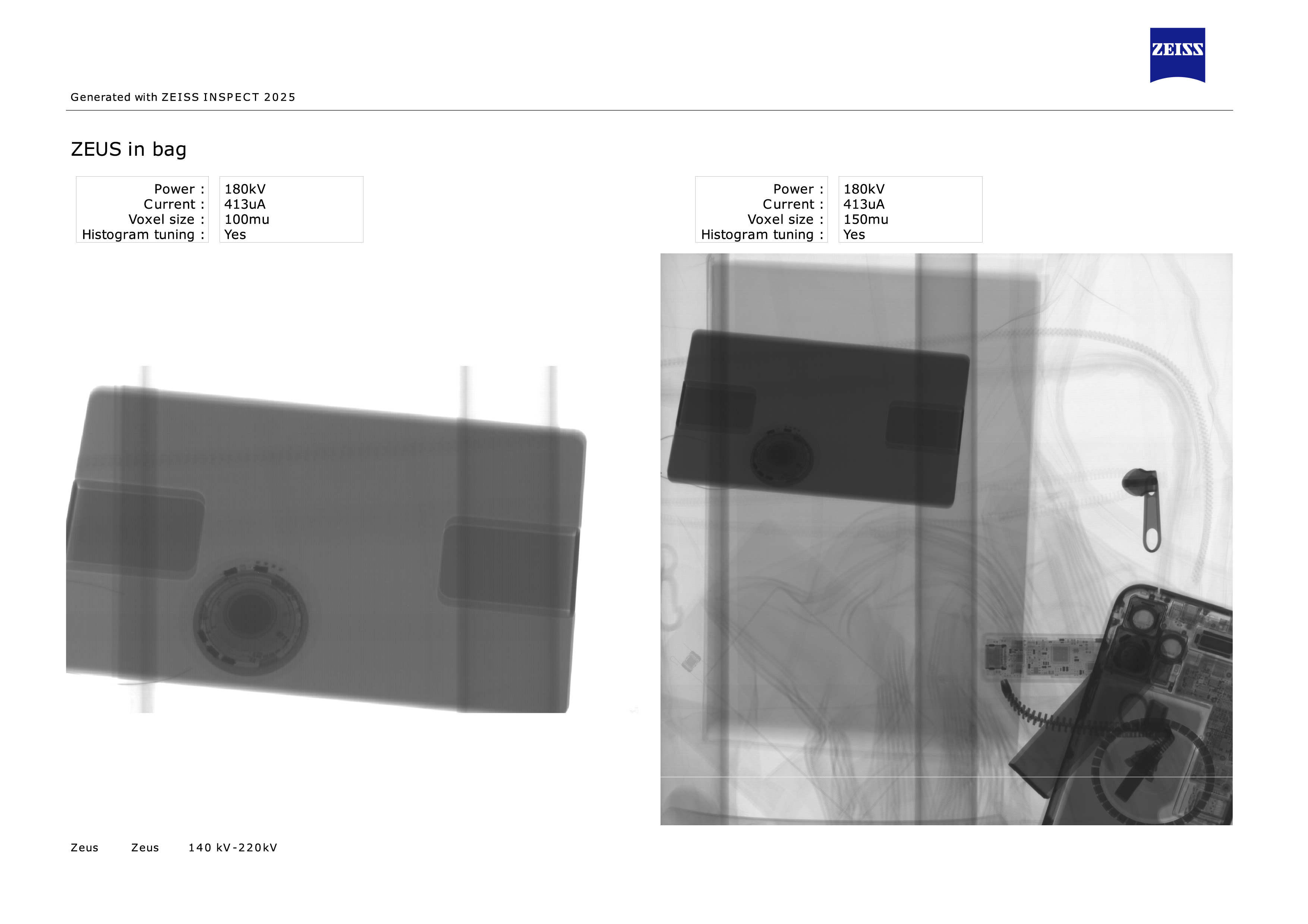
From the point of view of the machines themselves, the conclusion is straightforward.
Airport X-ray and CT scanners cannot read your seed phrase through assembled Cryptotag plates. Even when we used a high-end MetroTom 1500 CT system at 140–220 kV, 200–800 µA, and voxel sizes down to 39 µm, we were not able to reconstruct the seed through two 3 mm titanium plates.
In the most extreme lab settings, we saw small parts of some dents, but never enough information to recover words or phrases.
There is still one factor no test can eliminate: people.
Any object can attract attention at security. A chunky titanium plate is no different from a camera, a tool, or a weird piece of electronics in that sense. A security agent might decide to open your bag, ask what it is, or swab it for explosives or for other purposes. That’s always a possibility, with or without Cryptotag.
The important thing is that the scanner itself isn’t exposing your secret. The only remaining “risk” is human curiosity or policy, not some hidden X-ray superpower that can read through your metal.
In day-to-day terms, this is how we’d suggest you travel:
Keep your Cryptotag in your hand luggage, not buried in checked baggage. It’s easier to keep an eye on and easier to explain if someone asks. Leave the plates assembled, so the inner punched surfaces continue to face each other exactly as in our tests.
If a security agent does ask about it, a simple description usually works best: “It’s a titanium backup plate for important personal data.”
You don’t have to say “Bitcoin” or “seed phrase” unless you feel comfortable doing so. Most agents just want to know that it’s a legitimate, non-dangerous item, and then they move on to the next passenger.
Stay calm, be polite, and let the plate speak for itself. It’s built to survive far worse than a conveyor belt.
We partnered with Carl Zeiss SMT (Zeiss Metrology)—a global leader in industrial metrology—to push Cryptotag far beyond typical airport conditions. Using a MetroTom 1500 CT system in Breda, we scanned two 3 mm titanium plates with the seed punched on the inside, across voltages from 140 to 220 kV, currents from 200 to 800 µA, and voxel sizes as fine as 39 µm.
Even with that level of equipment and attention, the seed phrase remained unreadable.
So here’s the simple answer you can keep in mind the next time you’re in the security line:
Yes, it is safe to take your Cryptotag through both X-ray and CT scanners at the airport. The machines can see that you’re carrying a metal plate, but not the secret it protects. There are, however, some extra things you could think of when taking your Cryptotag through airport security.
The good news is: airport scanners can’t read your seed. But there are still a few smart habits that make traveling with your backup even safer in the real world.
If your wallet supports it, we strongly recommend using a BIP39 passphrase – often called the “25th word”.
Your 24 words then become only part of the secret. Even if someone were somehow able to see or photograph your CRYPTOTAG (for example, if you’re forced to open it at a secondary inspection), the 24 punched words are useless without the extra passphrase.
In practice, this means:
Anyone with just the plate has a very pretty piece of titanium and nothing else.
We generally don’t advise storing your seed phrase in any app on your phone. A plain-text note is usually the worst possible place for long-term storage.
However, if you are very paranoid about border or customs situations, there is a specific, temporary use case:
If you go this route, treat it as a purely temporary, emergency-only tool:
This is not the “Cryptotag way” and absolutely not our default recommendation, but for some high-threat scenarios, it’s a trade-off people consciously choose to make.
A few simple habits go a long way:
With the right setup (titanium backup + passphrase + good travel hygiene), you can walk through any scanner in the world knowing that the machine, and the people around it, still don’t have your keys.
The best hodl stories, OPSEC tips, and weekly updates of the market.
 Weekly hodl insightsBonus content accessExclusive offers